About this routine
Five bodyweight exercises that cover legs, chest, back and core. You need a floor and enough room to lunge. Do it 3 times a week on non-consecutive days.
For anyone starting out, coming back after a break, or training at home without weights. Most moves have an easier version if a full rep is too hard today.
The week
3 days a week
A day off between sessions lets your muscles recover. A walk on rest days helps.
- MFull body
- TRest
- WFull body
- TRest
- FFull body
- SRest
- SRest
The workout
Before you start
If you have a medical condition or an injury, check with a doctor before starting a new exercise routine.
Stop any exercise that causes pain, dizziness, or strain somewhere you don't expect it.
Warm-up, about 5 minSee moves
- Spot jog45 seconds
- Jumping jacks30 seconds
- Arm circles10 each way
- Hip circles8 each way
- Bodyweight squat10 reps
- Light practice set of Bodyweight Squat1 to 2 sets
-
1
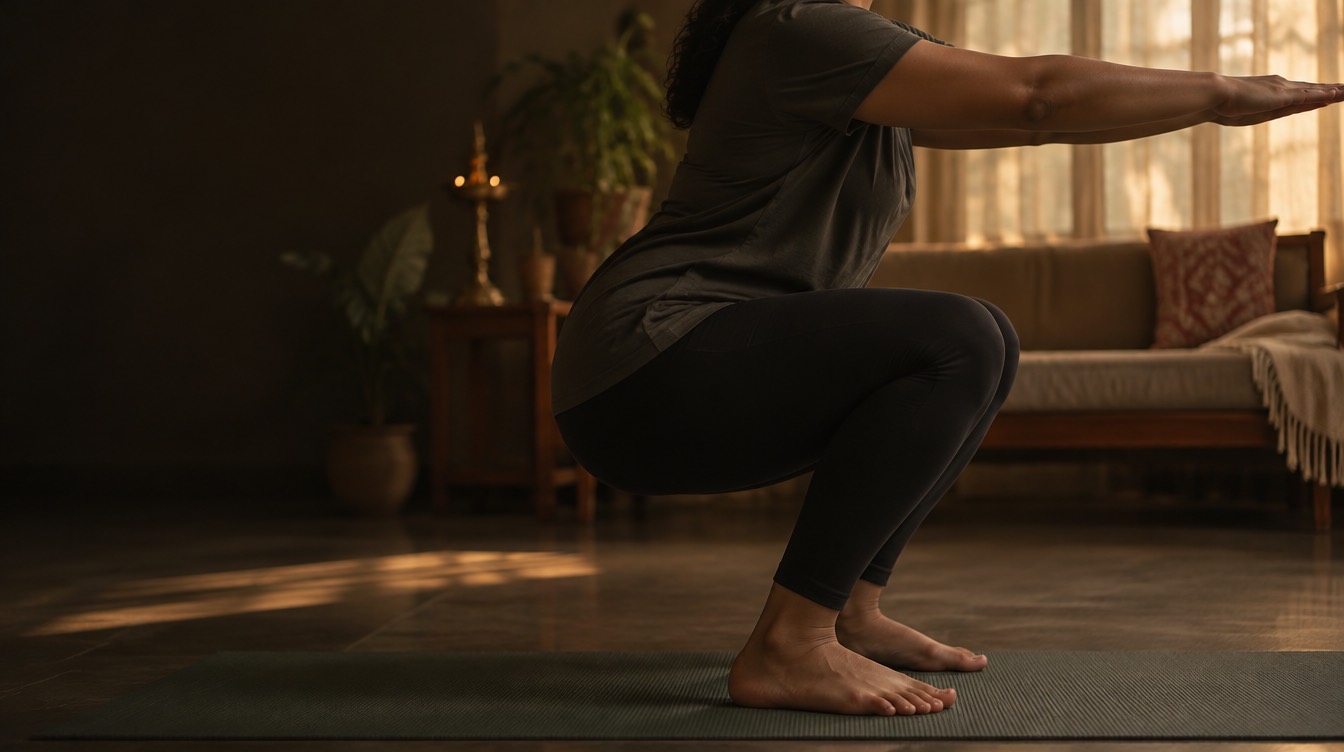
Bodyweight Squat
3 × 12 to 15 repsQuadriceps
How to do it
- Stand with your feet about shoulder-width apart, toes turned out slightly, arms in front of you.
- Sit your hips back and down, letting your knees follow your toes.
- Go down until your thighs are level with the floor, or lower if your heels stay down and your chest stays up.
- Push the floor away to stand back up.
- Stand fully tall at the top before the next rep.
-
2
Push up
3 × 8 to 12 repsChest
How to do it
- Hands on the floor slightly wider than your shoulders, legs straight behind you.
- Tighten your stomach so your body stays in a straight line from head to heels.
- Lower your chest toward the floor, elbows angled slightly back rather than straight out.
- Push the floor away to come back up.
- Too hard? Do them with your knees on the floor, or your hands on a chair.
-
3
Forward Lunge
3 × 8 to 12 repsQuadriceps
How to do it
- Stand tall, feet hip-width apart, hands on your hips.
- Take a step forward and lower until both knees are bent, back knee just above the floor.
- Keep your chest up and your front knee in line with your toes.
- Push off your front foot to step back to the start.
- Do all reps on one leg, then switch. Hold a wall or chair if you lose your balance.
-
4
Superman
3 × 12 to 15 repsLower back
How to do it
- Lie face down with your arms stretched past your head and your legs straight.
- Squeeze your bottom and tighten your stomach.
- Lift your arms, chest and legs a few centimetres off the floor. A small lift is enough.
- Hold for a second, then lower slowly.
- Look at the floor to keep your neck long. Stop if you feel a pinch in your lower back.
-
5
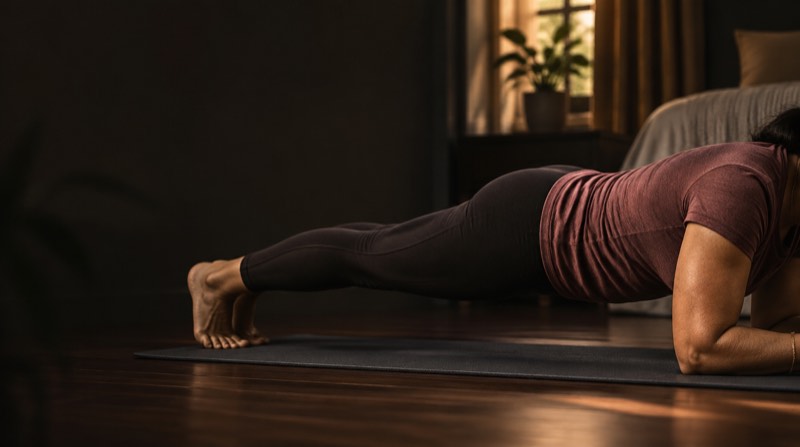
Front Plank
3 × 20 secAbdominals
How to do it
- Rest on your forearms with your elbows under your shoulders and your legs straight behind you.
- Brace: tighten your stomach as if someone is about to poke it, and squeeze your bottom.
- Keep your body in a straight line from head to heels. Do not let your hips drop or raise your bottom up.
- Breathe steadily and hold. Too hard? Drop your knees to the floor.
- Stop if you feel it in your lower back.
Cool-down, about 3 minSee moves
- Easy walk1 minute
- Chest stretch30 seconds
- Quad stretch30 seconds each leg
- Child's pose30 seconds
Rest and progress
Rest between sets
- Rest 60 seconds between sets. If you are out of breath, take 90.
- Move from one exercise to the next once you have caught your breath.
How to progress
- Weeks 1 and 2: learn the moves. Stop each set 2 or 3 reps before it gets hard.
- Then add reps. When you reach the top of the rep range on every set, make the move harder: slow the lowering to 3 seconds, or switch to the harder version below.
- After 6 to 8 weeks of reaching the top of every range, move up to the Bodyweight Strength workouts at the bottom of this page.
Swaps
- Push up too hard
- Push up with hands on a table, kitchen counter or wall. Lower the hands as you get stronger.
- Push up too easy
- Feet on a chair (Decline Push Up), or a 3 second lowering.
- Lunges hurt your knees
- Reverse lunges, stepping back instead of forward, or a shorter step.
- Squats too easy
- Pause 2 seconds at the bottom, or try Bulgarian split squats with your back foot on a chair.
Short on time: the 10 minute version
Two rounds, little rest. Better than skipping a day.
Warm-up, about 5 minSee moves
- Spot jog45 seconds
- Jumping jacks30 seconds
- Arm circles10 each way
- Hip circles8 each way
- Bodyweight squat10 reps
- Light practice set of Jumping Jack1 to 2 sets
-
1
Jumping Jack
2 × 30 secQuadriceps
How to do it
- Stand tall, feet together, arms by your sides.
- Jump your feet out wide as you raise your arms overhead.
- Jump back to the start. Land softly with your knees slightly bent.
- Keep a steady rhythm. To make it easier, step one foot out at a time instead of jumping.
-
2
Bodyweight Squat
2 × 12 to 15 repsQuadriceps
How to do it
- Stand with your feet about shoulder-width apart, toes turned out slightly, arms in front of you.
- Sit your hips back and down, letting your knees follow your toes.
- Go down until your thighs are level with the floor, or lower if your heels stay down and your chest stays up.
- Push the floor away to stand back up.
- Stand fully tall at the top before the next rep.
-
3
Push up
2 × 8 to 12 repsChest
How to do it
- Hands on the floor slightly wider than your shoulders, legs straight behind you.
- Tighten your stomach so your body stays in a straight line from head to heels.
- Lower your chest toward the floor, elbows angled slightly back rather than straight out.
- Push the floor away to come back up.
- Too hard? Do them with your knees on the floor, or your hands on a chair.
-
4
Mountain Climber
2 × 30 secAbdominals
How to do it
- Start at the top of a push-up: hands under your shoulders, arms straight, body in a line.
- Tighten your stomach and keep your hips level with your shoulders.
- Drive one knee toward your chest, then switch legs quickly, like running in place.
- This is a cardio move, so keep a quick, steady pace. Slow down if your hips start bouncing.
- Too hard? Put your hands on a chair or step.
-
5
Front Plank
2 × 20 secAbdominals
How to do it
- Rest on your forearms with your elbows under your shoulders and your legs straight behind you.
- Brace: tighten your stomach as if someone is about to poke it, and squeeze your bottom.
- Keep your body in a straight line from head to heels. Do not let your hips drop or raise your bottom up.
- Breathe steadily and hold. Too hard? Drop your knees to the floor.
- Stop if you feel it in your lower back.
Cool-down, about 3 minSee moves
- Easy walk1 minute
- Chest stretch30 seconds
- Quad stretch30 seconds each leg
- Child's pose30 seconds
When it gets easy: Bodyweight Strength
Harder versions of the same patterns, split into an upper and a lower day. Uses a chair and a step. Run it 4 days a week, alternating upper and lower.
Upper · about 30 min
| Decline Push Up | 4 × 10 to 15 reps |
| Pike Push up | 4 × 10 to 15 reps |
| Lying Prone Y Raise | 4 × 12 to 20 reps |
| Dip on Floor with Chair | 4 × 10 to 15 reps |
| Prone Snow Angel | 4 × 12 to 20 reps |
| Superman | 4 × 12 to 20 reps |
Lower · about 30 min
| Bulgarian Split Squat with Chair | 4 × 10 to 15 reps |
| Reverse to Forward Lunge | 4 × 10 to 15 reps |
| Bodyweight Single Leg Deadlift | 4 × 10 to 15 reps |
| Alternate Single Leg Glute Bridge | 4 × 10 to 15 reps |
| Single Leg Calf Raise Off Step | 4 × 12 to 20 reps |
| Jump Squat | 4 × 8 to 10 reps |
In the Akhada app: Bodyweight Strength Upper, Bodyweight Strength Lower.
Questions
Can you build muscle with no equipment?
Yes, especially in the first months. Muscles respond to hard sets, not to the tool. The limit comes later, when even the harder versions get easy. That is the time to add a pair of dumbbells or a band.
How long does this workout take?
About 20 minutes, plus a 5 minute warm-up. The 10 minute version fits a lunch break.
How often should I do it?
Three times a week with a day off in between, for example Monday, Wednesday and Friday.
Will this help me lose weight?
It can help. Training builds and keeps muscle, and nutrition is the other big factor in weight loss, so it is worth looking at too.
I can't do a single push up. What now?
Start with your hands on a wall or a table. Do the reps there, and lower the surface each time the top of the rep range feels easy, until you reach the floor.
More routines


Sources
The Akhada team picked these exercises from our catalog of 7,000+ demonstrated movements. A strength coach reviewed the step-by-step cues for every exercise in our starter routines, these included. The schedule and progression follow the research below.
-
Muscle growth was similar with light and heavy loads when every set was taken to failure. That is why bodyweight training works, as long as the last reps of each set are hard.
-
Push-ups built as much muscle and strength as a load-matched bench press over 8 weeks.
-
Adults should do muscle-strengthening work for all major muscle groups on 2 or more days a week. Three full body sessions cover that.
-
The ACSM recommends 2 to 3 training days a week for beginners. That is the schedule here.